
Hackathon project 02 · ETHGlobal Taipei
10 / 12
ETHGlobal Taipei
One multichain stablecoin submission that won Circle and Hyperlane sponsor prizes for its payment and interchain position flows.
- Role
- Frontend & Product UI/UX Lead · 2025
- Problem
- The UI had to preserve one user goal while value transfer, interchain messaging, and target execution progressed independently.
- Strategy
- The frontend modeled source, transfer, message, target, and portfolio states separately. Each stage kept its own progress and reference while the product preserved one continuous user goal.
- Outcome
- Won Circle’s official Build a Multichain USDC Payment System sponsor prize at ETHGlobal Taipei 2025.
2 Sponsor Prizes · 2025
01
Problem definition
Why this problem had to be solved
This ETHGlobal Taipei submission combined social-login onboarding, smart accounts, multichain stablecoin positions, and cross-chain actions in one product. The same submission received Circle and Hyperlane sponsor prizes for two distinct integration strengths.
What users and the system were facing
Cross-chain value movement and interchain messages could complete on different timelines.
A successful source action did not mean the target-side position or portfolio was ready.
Users needed one coherent journey without operating every wallet, bridge, or protocol boundary manually.
Frontend ownership
I owned the frontend and product UI/UX for the shared ETHGlobal submission. Other team members owned Circle CCTP, Hyperlane, vault, account-abstraction, and optimization contracts and infrastructure.
Social-login and smart-account frontend
Multichain USDC balances, positions, and history
Cross-chain transfer and interchain message progress
Product framing for the Circle and Hyperlane prize tracks
02
Solution strategy
A system strategy carried into production
The frontend modeled source, transfer, message, target, and portfolio states separately. Each stage kept its own progress and reference while the product preserved one continuous user goal.
System model
A multichain action moves through source approval, value transfer and message observation, target execution, and portfolio reconciliation.
Product evidence
Selected product surfaces
Historical product interfaces. Values shown are captured UI states, not current TVL, APY, or performance claims.
Product and delivery map
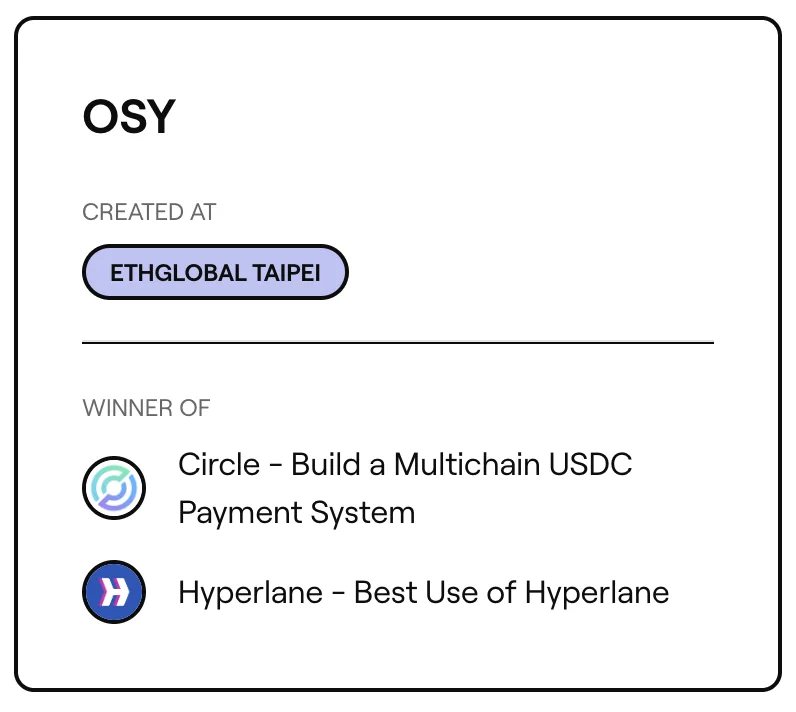
One submission, two prize-winning integrations
The same product and frontend were evaluated through two sponsor-track lenses. Circle focused on multichain USDC movement; Hyperlane focused on interchain position coordination.
Build a Multichain USDC Payment System
Circle sponsor prize
A product flow for moving USDC across chains while preserving onboarding, account, payment, and progress context.
Implementation details · 3
- Social-login and smart-account onboarding
- USDC balances, source execution, transfer observation, and target state
- Circle CCTP-oriented product framing
Best Use of Hyperlane
Hyperlane sponsor prize
An interchain position flow that treated message transport and target execution as visible product stages.
Implementation details · 3
- Interchain action and position UX
- Message progress, target execution, and portfolio reconciliation
- Hyperlane-oriented product framing
Implementation decisions
Presented multichain balances, positions, and destination context in one dashboard.
Separated source execution, value movement, message progress, target execution, and final portfolio state.
Connected smart-account actions to clear pending, success, and failure feedback.
Adapted one product demonstration to make the Circle and Hyperlane integration strengths legible without presenting them as unrelated submissions.
03
Outcome
What changed—and what I learned
Won Circle’s official Build a Multichain USDC Payment System sponsor prize at ETHGlobal Taipei 2025.
Won Hyperlane’s official Best Use of Hyperlane sponsor prize at ETHGlobal Taipei 2025.
Published one shared submission through the official showcase and public frontend repository.
Learning
Cross-chain UX becomes trustworthy when asset movement, message transport, target execution, and the final product outcome are represented as distinct stages.
Today
I would add a server-authoritative process record, CCTP and message identifiers, relayer observability, idempotent retries, and tests for delayed or partially completed target execution.
Built with
Public links
Work together