
Independent browser game
06 / 12
Tiny Volley
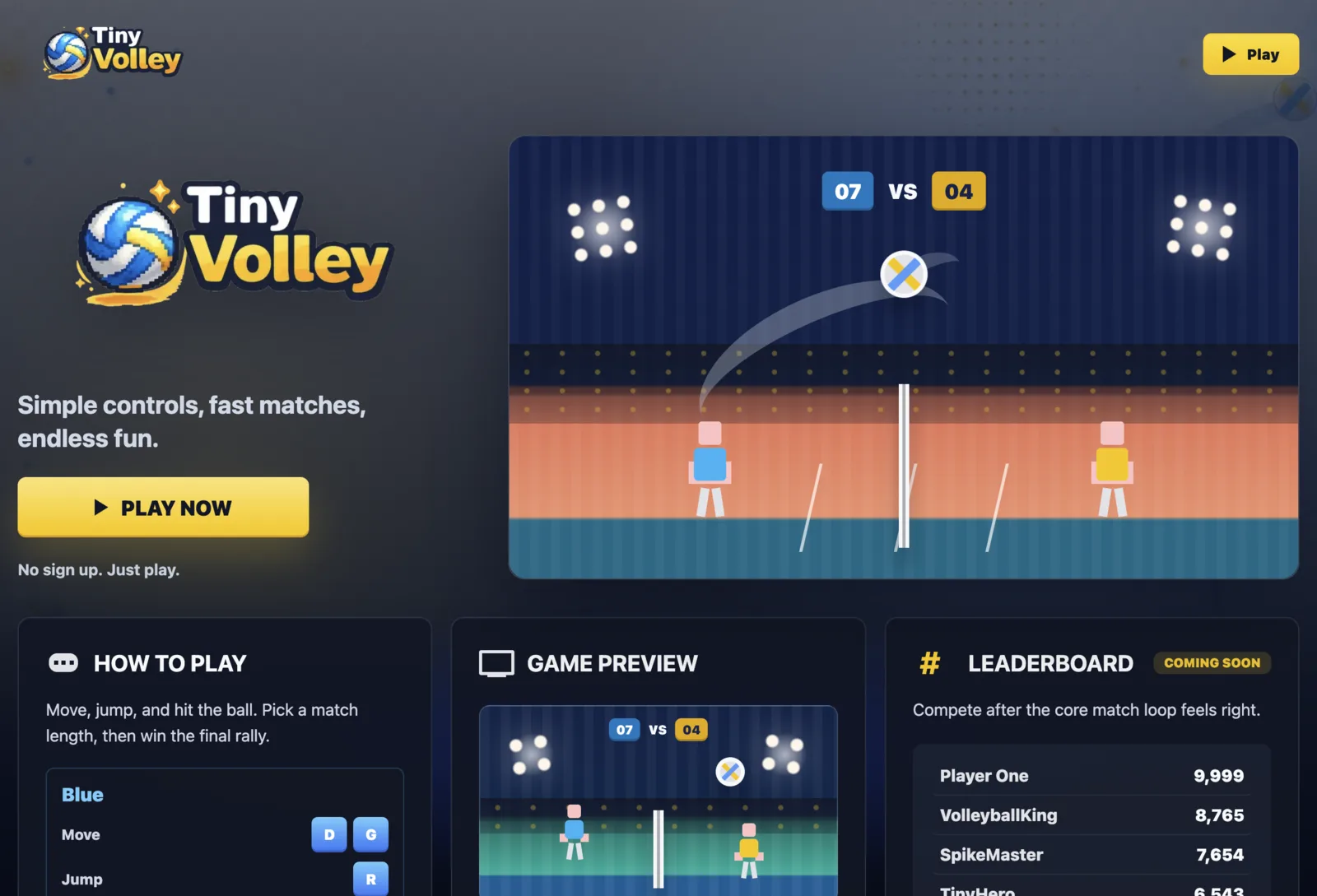
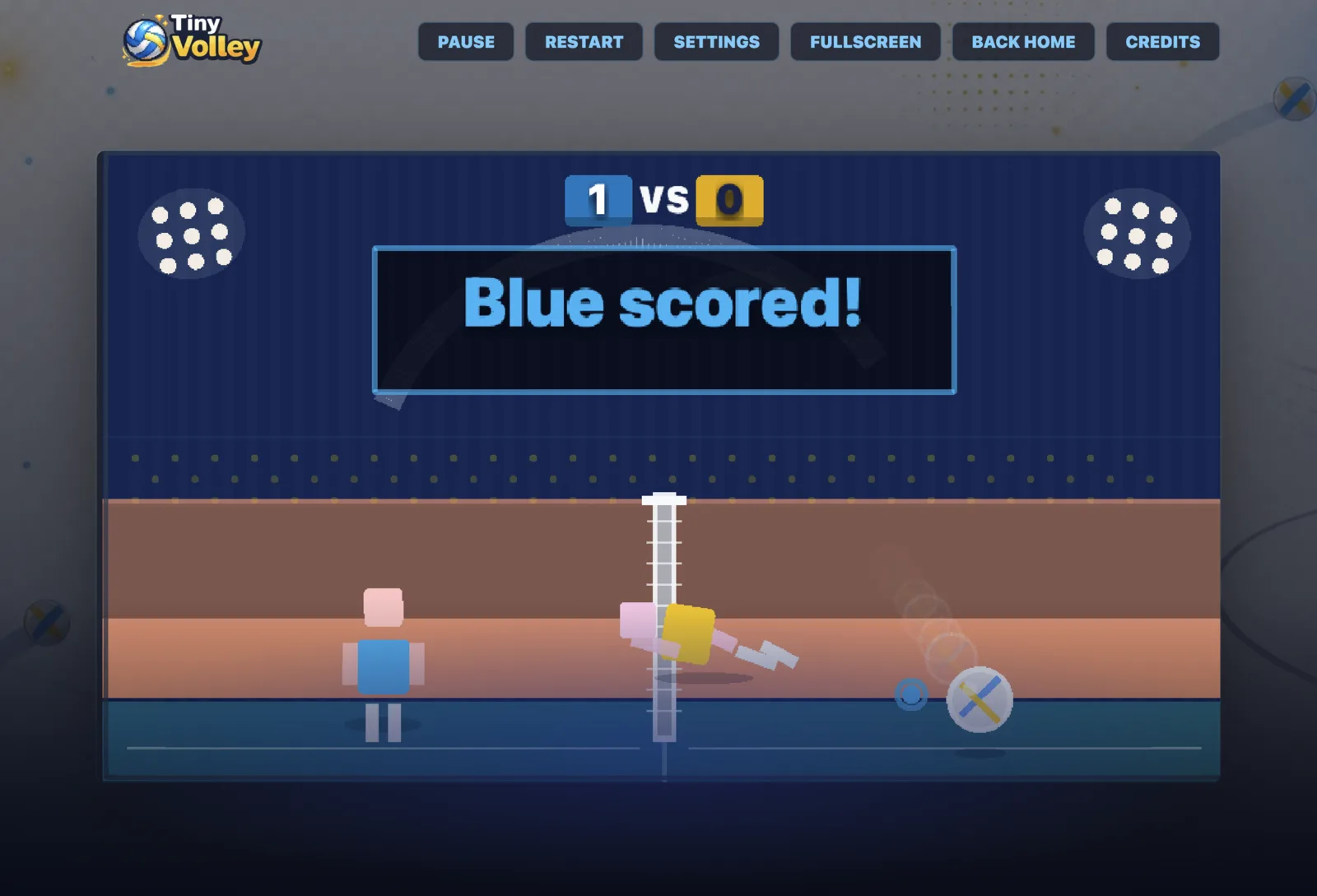
A playable browser volleyball game with local multiplayer, AI, mobile controls, and peer-to-peer online rooms.
- Role
- Independent Developer · Apr — May 2026
- Problem
- Online play had to preserve the same match state on two browsers without turning rendering or network timing into the source of truth.
- Strategy
- The game advances a pure deterministic simulation from synchronized input frames. Phaser renders the resulting state, while the networking layer handles room and peer lifecycle without changing game rules.
- Outcome
- Released a playable Cloudflare-hosted browser game with local, AI, mobile, and peer-to-peer online modes.
Live independent build · 2026
01
Problem definition
Why this problem had to be solved
Tiny Volley is a small browser volleyball game. Local play, AI, rendering, and online matches all use the same TypeScript match simulation.
What users and the system were facing
Game rules, physics, controls, rendering, and networking could drift if each mode owned a different version of match state.
Peer-to-peer play needed room lifecycle, signaling, disconnect, timeout, and reconnection feedback—not only a DataChannel connection.
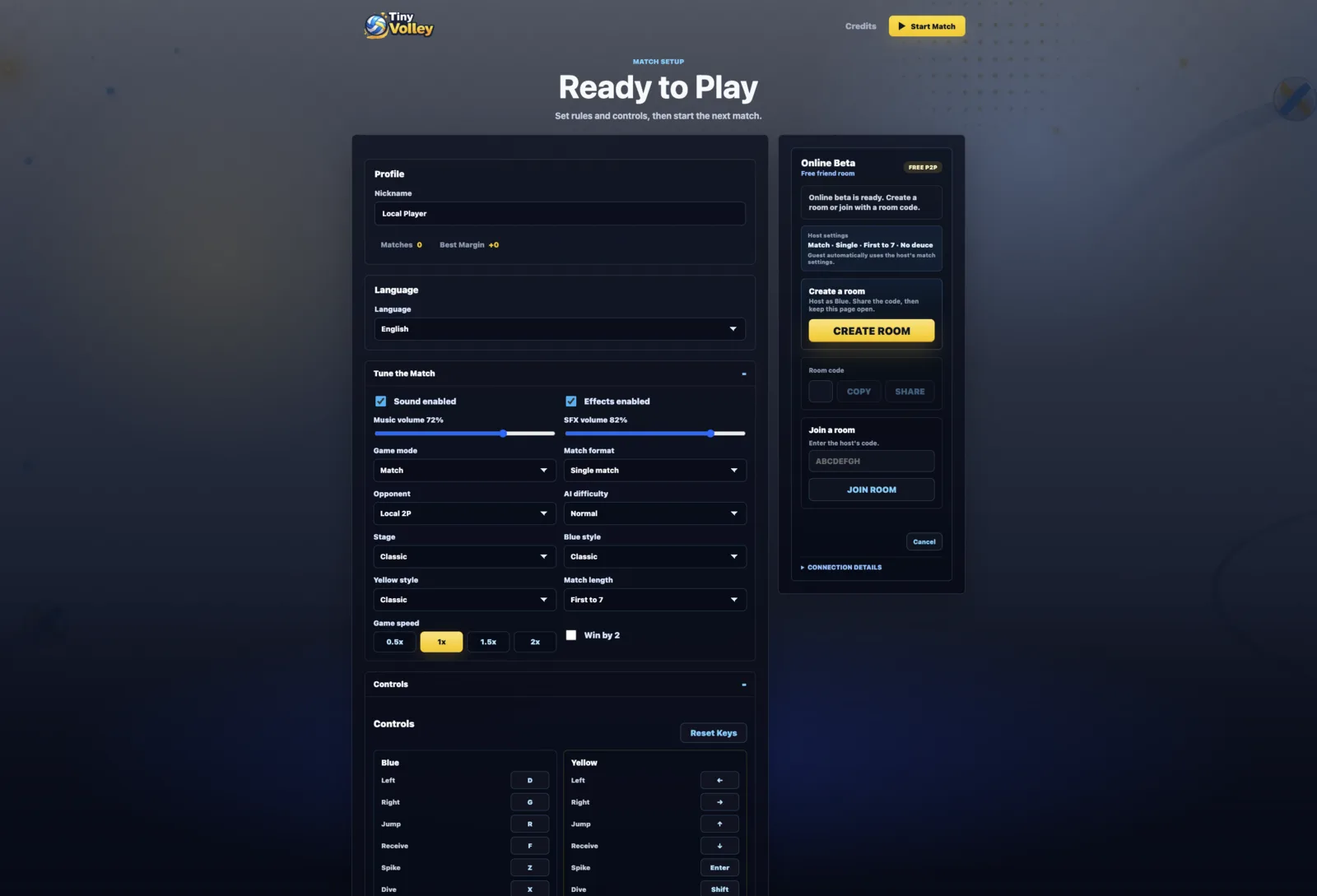
Desktop keyboard, local two-player, mobile touch, and persisted controls had to share one readable setup experience.
Frontend ownership
As an independent build, I designed and implemented the game client, deterministic simulation, AI, responsive controls, WebRTC lockstep, and the Cloudflare Worker signaling service.
Pure TypeScript match simulation separated from Phaser rendering
Local two-player, single-player AI, and mobile touch controls
WebRTC DataChannel lockstep and room lifecycle
Cloudflare Workers, Durable Objects, localization, and automated tests
02
Solution strategy
A system strategy carried into production
The game advances a pure deterministic simulation from synchronized input frames. Phaser renders the resulting state, while the networking layer handles room and peer lifecycle without changing game rules.
System model
Both peers exchange input frames through WebRTC, advance the same deterministic simulation, and render the resulting match state independently.
Product evidence
Selected product surfaces
Historical product interfaces. Values shown are captured UI states, not current TVL, APY, or performance claims.
Implementation decisions
Kept authoritative rules and physics in a deterministic simulation so local and remote peers could advance the same inputs through the same state.
Built room creation, shareable codes, signaling, heartbeat, timeout, disconnect, and explicit STUN-only connection failure states.
Added remappable persisted controls, multiple game modes, sound and effects settings, and ten interface languages.
Tested simulation, input, protocol, and room behavior independently from the Phaser renderer.
03
Outcome
What changed—and what I learned
Released a playable Cloudflare-hosted browser game with local, AI, mobile, and peer-to-peer online modes.
Passed 101 automated tests across 18 files, the production game build, and the Worker type check during the Jul 2026 portfolio audit.
Exposed the current STUN-only limitation honestly instead of implying that peer-to-peer rooms work across every network.
Learning
Realtime frontend reliability comes from making simulation, rendering, transport, and connection lifecycle separate systems with explicit contracts.
Today
I would lazy-load the Phaser game runtime after the setup route and add an optional TURN service for networks where direct peer connectivity fails.
Built with
Public links
Work together